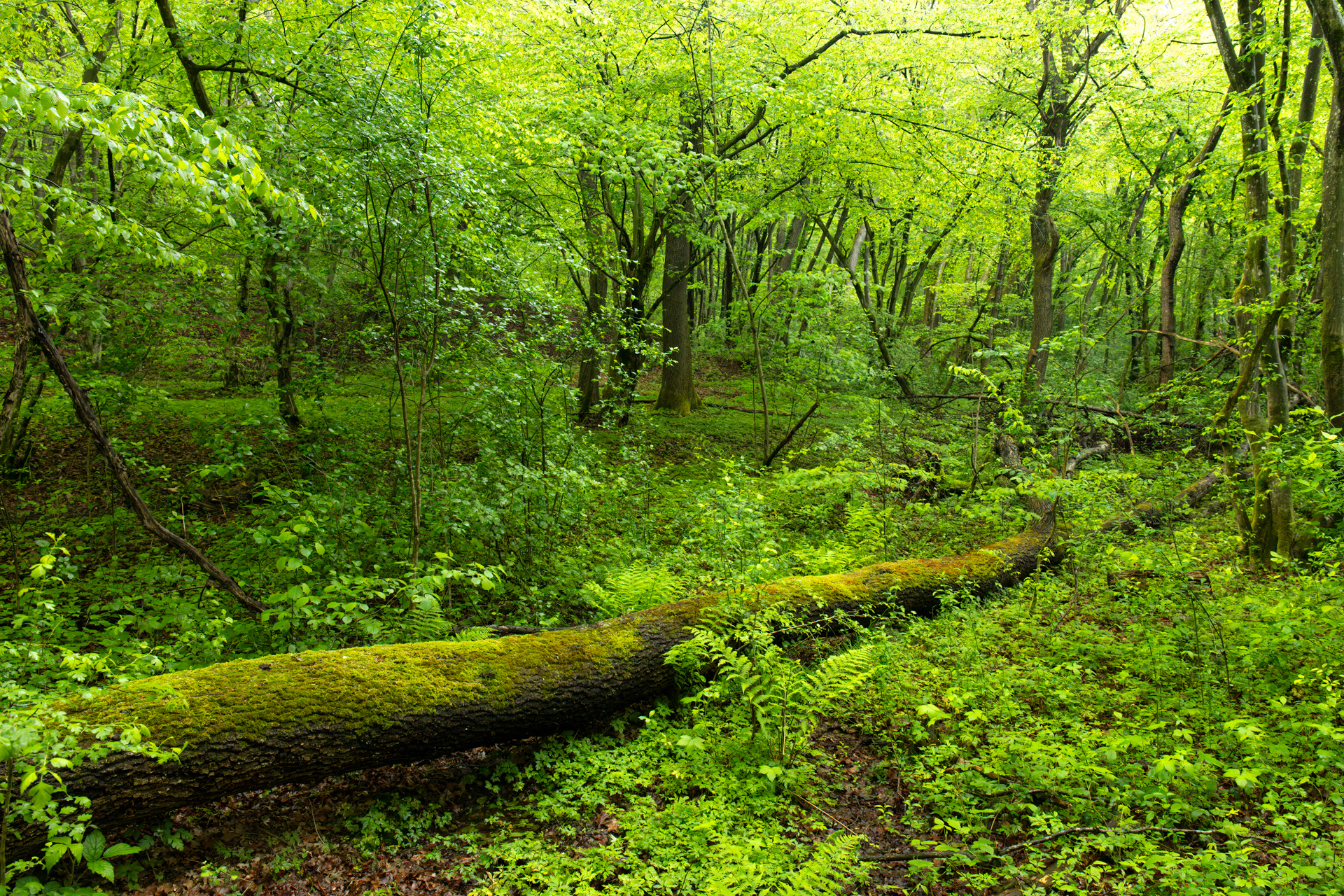
In recent decades, a quiet but profound transformation has taken place across much of Italy. The rarefaction of traditional forestry practices—even in the hills and lowlands—has allowed many woodlands to return to a more natural state. Where trees were once managed, cut, and cleared with regularity, now they are left to grow, age, and fall in their own time. Ancient-looking woods, rich in towering trees and strewn with dead trunks and branches, have begun to spread, even in the Po Valley and its surrounding foothills.
These forgotten corners of forest—though altered and still far from their original, wild state—possess a kind of evocative magic. Despite the presence of non-native species, they offer refuge to wildlife, protected in part by their inaccessibility. And it’s not just nature lovers and photographers who have noticed them. Many forest-dwelling species are benefiting from the return of these mature ecosystems. Iconic insects like the stag beetle (Lucanus cervus), strictly associated with dead trunks, and nocturnal raptors like the tawny owl (Strix aluco), breeding and dailiy resting preferentially on tree cavities, are now being spotted in areas where they had been absent for decades.
Among the species taking advantage of the increasing number of old, hollow trees is the unexpected case of the Black Woodpecker (Dryocopus martius). Once limited to mid-altitude forests of beech and conifers, it has now become a familiar sight even in the lowlands, sometimes even in city parks, provided there are large, mature trees (especially plane trees). It’s a curious reversal of the usual trend we see today, with many species shifting to higher elevations in response to warming climates.
The full set of factors behind the Black Woodpecker’s expansion into lower elevations is still unclear. It's likely not just about the abundance of old trunks, but also its habitat generalism (in term of wood composition) and the increase of protected woodlands. Whatever the reasons, its presence remains one of the more fascinating ornithological puzzles in recent times.
I remember one particular morning in late February. I was walking through a damp, old forest, looking for amphibians, when I heard that unmistakable springtime call of a male Black Woodpecker. It wasn’t easy to follow him through the dense branches, but eventually I caught sight of a vivid red spot on the trunk of an old plane tree, already marked by several large, deep cavities. I raised my binoculars: and there he was, his black silhouette sharp and majestic. Moments later, answering his soft drumming, the female arrived too.
From that moment on, I began cultivating the dream, later fulfilled, of following the breeding season of that pair of black woodpeckers, from their earliest courtship displays all the way to the fledging of their young.
The pair seemed to have chosen a small group of two or three old plane trees nestled at the bottom of a narrow wooded valley, surrounded by a few, but majestic, hornbeams and oaks. Fortunately, the positioning of those trunks allowed for a good view of the nest holes from both sides of the valley, with no excessive upward-looking perspectives.
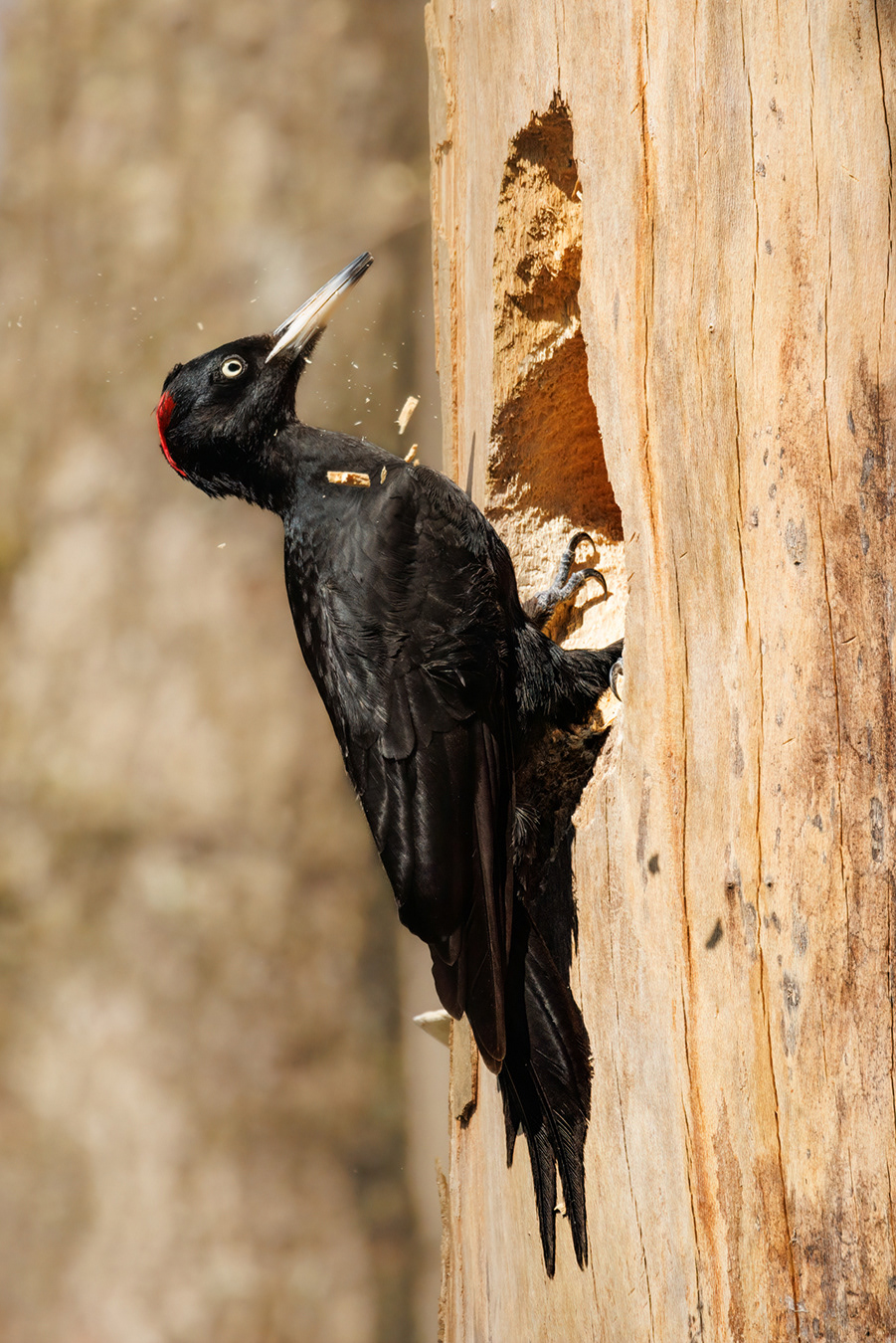
It wasn’t an easy life. After their first loud and confident displays of intent, silent days followed, filled with doubts and uncertainties. I remember one particular day, probably due to the rain, when the two woodpeckers didn’t appear at all, and I feared they might have chosen another nesting site, perhaps disturbed by my presence. But then, a few days later, when I returned, I noticed a fresh, shallow excavation in one of the tree trunks. Almost in disbelief, I soon witnessed the arrival of the female, who tirelessly resumed the digging work. A short while later, the male joined in too. In just a few days, the cavity was so deep that the birds could fully enter and poke only their beaks out. Beaks full of wood chips, which they expelled at the base of the tree.
The pair seemed to have chosen a small group of two or three old plane trees nestled at the bottom of a narrow wooded valley, surrounded by a few, but majestic, hornbeams and oaks. Fortunately, the positioning of those trunks allowed for a good view of the nest holes from both sides of the valley, with no excessive upward-looking perspectives.
It wasn’t an easy life. After their first loud and confident displays of intent, silent days followed, filled with doubts and uncertainties. I remember one particular day, probably due to the rain, when the two woodpeckers didn’t appear at all, and I feared they might have chosen another nesting site, perhaps disturbed by my presence. But then, a few days later, when I returned, I noticed a fresh, shallow excavation in one of the tree trunks. Almost in disbelief, I soon witnessed the arrival of the female, who tirelessly resumed the digging work. A short while later, the male joined in too. In just a few days, the cavity was so deep that the birds could fully enter and poke only their beaks out. Beaks full of wood chips, which they expelled at the base of the tree.
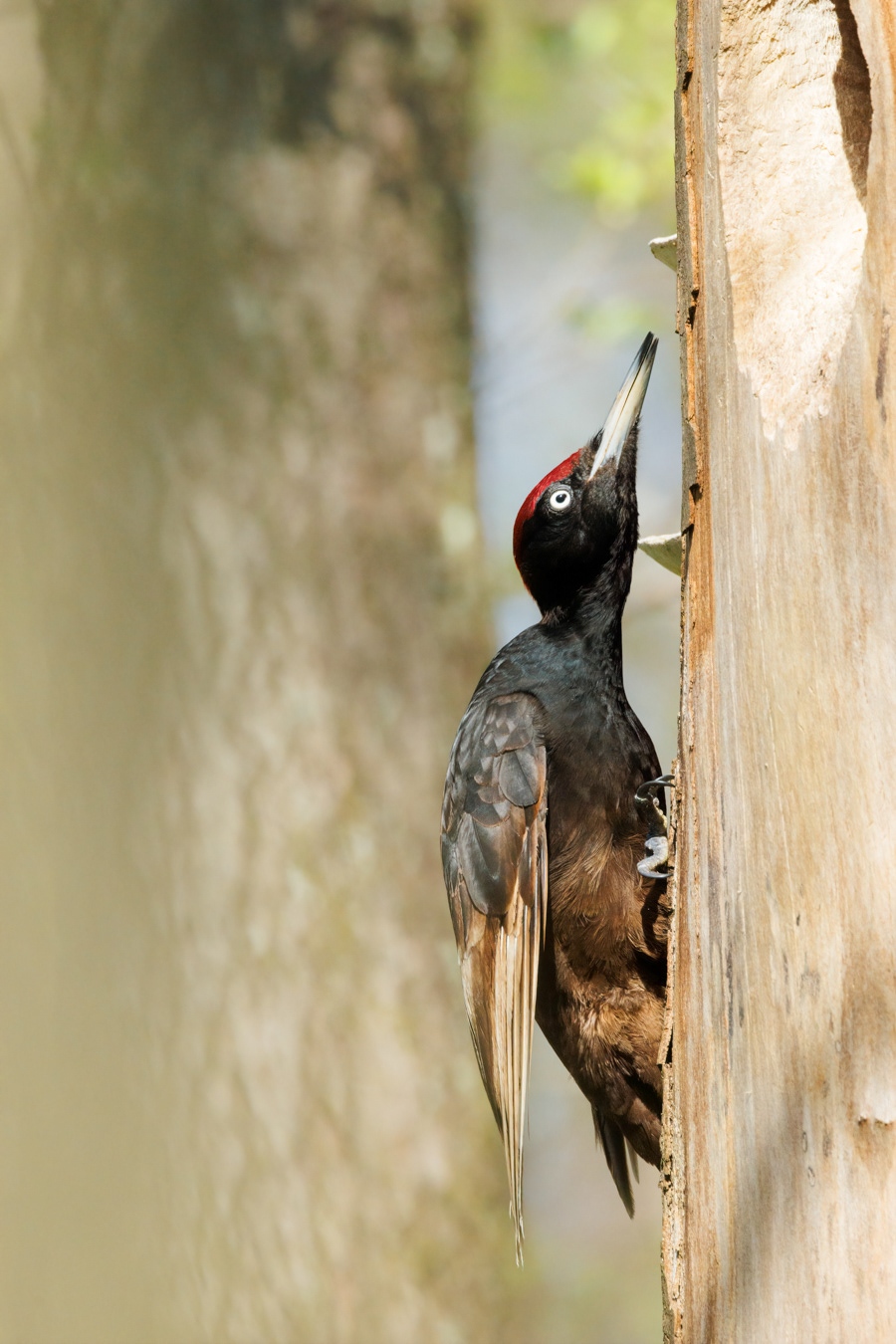
From there, it became a magnificent adventure. I used to arrive before dawn, making sure there was no activity yet around the nest. Once I set up my camouflage hide, I used to retreat myself inside and, in a sense, disappear, or become part of the trees, branches, and leaves. At least, that’s how it seemed to the woodpeckers, and to the many other animals of the forest. Each morning, the calls of a pair of tawny owls echoed not far away, until, eventually, the faint peeping of their chicks joined in. I never did manage to spot them anyway. The forest and its terrain often deceive, and the direction of a call isn’t always easy to locate.
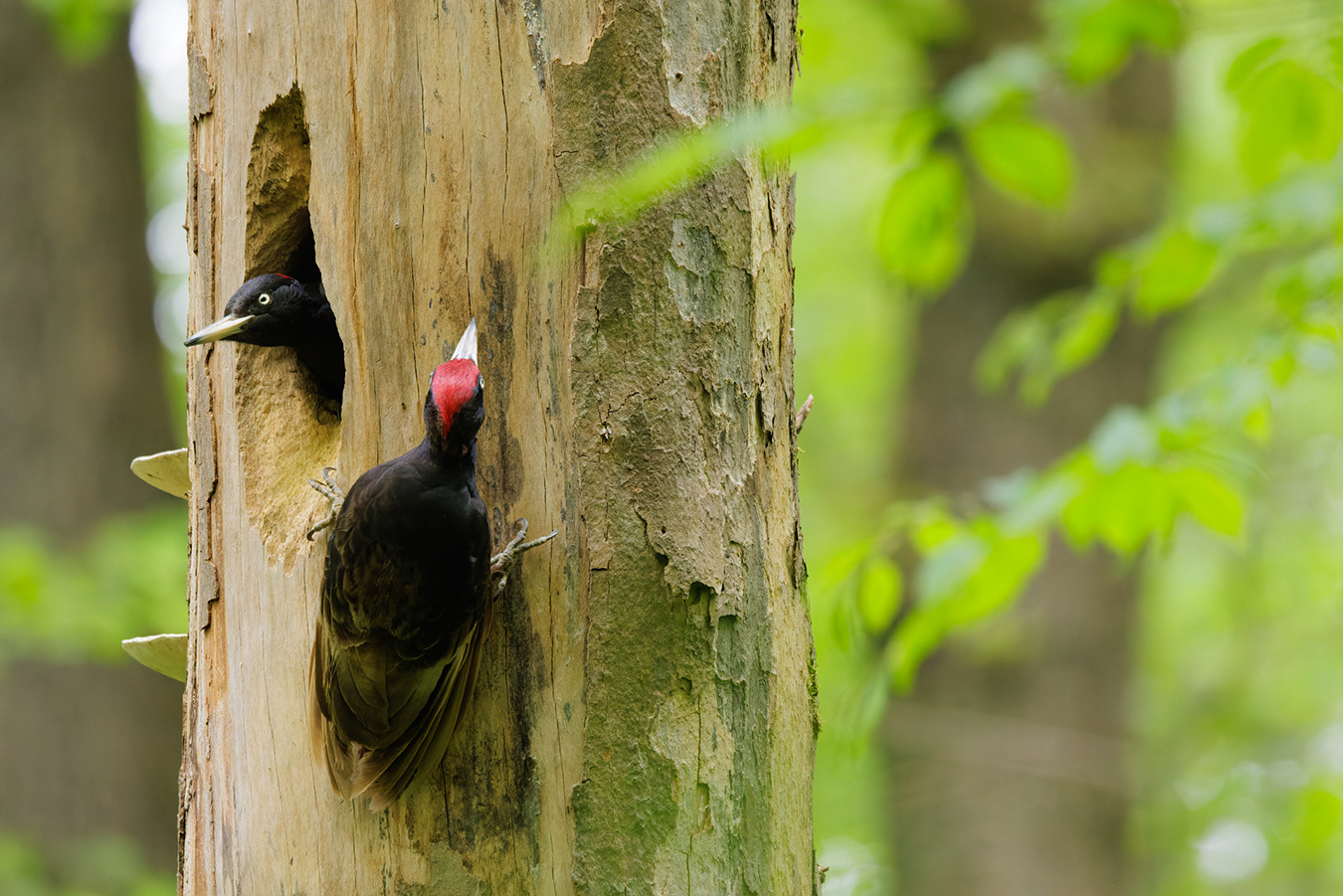
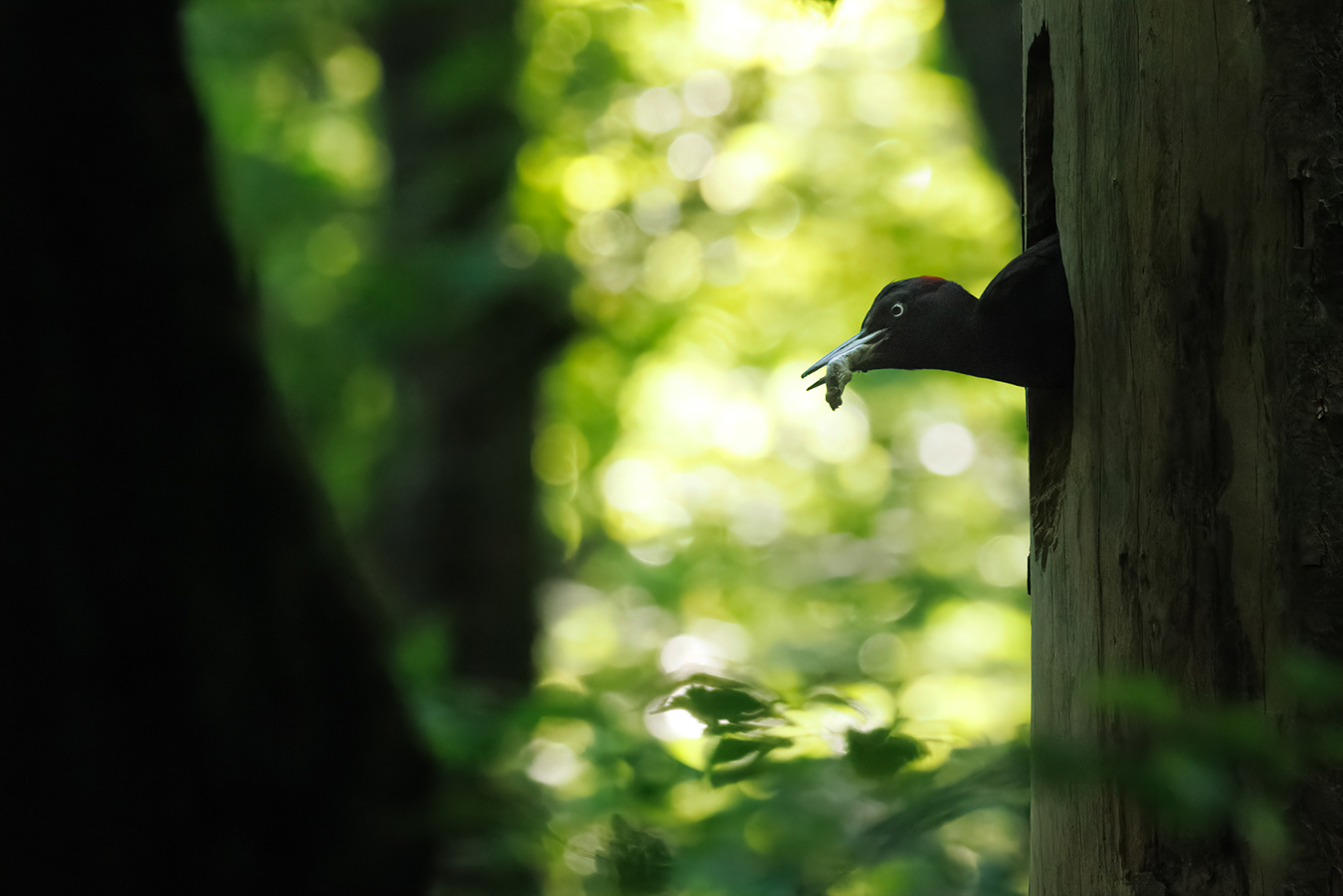
Sometimes it was the male woodpecker’s typical call “crek-crek-crek” call that signaled his arrival. Other times, it was the sound of his powerful wings cutting through the still forest air. And occasionally, they arrived in complete silence: just a gentle tapping on a nearby trunk, or the sudden appearance of a little red-topped head sticking out from the tree right in front of my hide, almost as if to challenge me playfully, with a teasing look. During incubation, when one parent returned to the nest, the other flied off soon after, searching likely for a decaying tree or a busy ant nest to feed. When feeding the chicks, however, they took turns at the nest, though visits were less frequent. Black woodpeckers store food in their crop and regurgitate it directly into the mouths of their young. Except when the prey is particularly large and difficult to swallow!
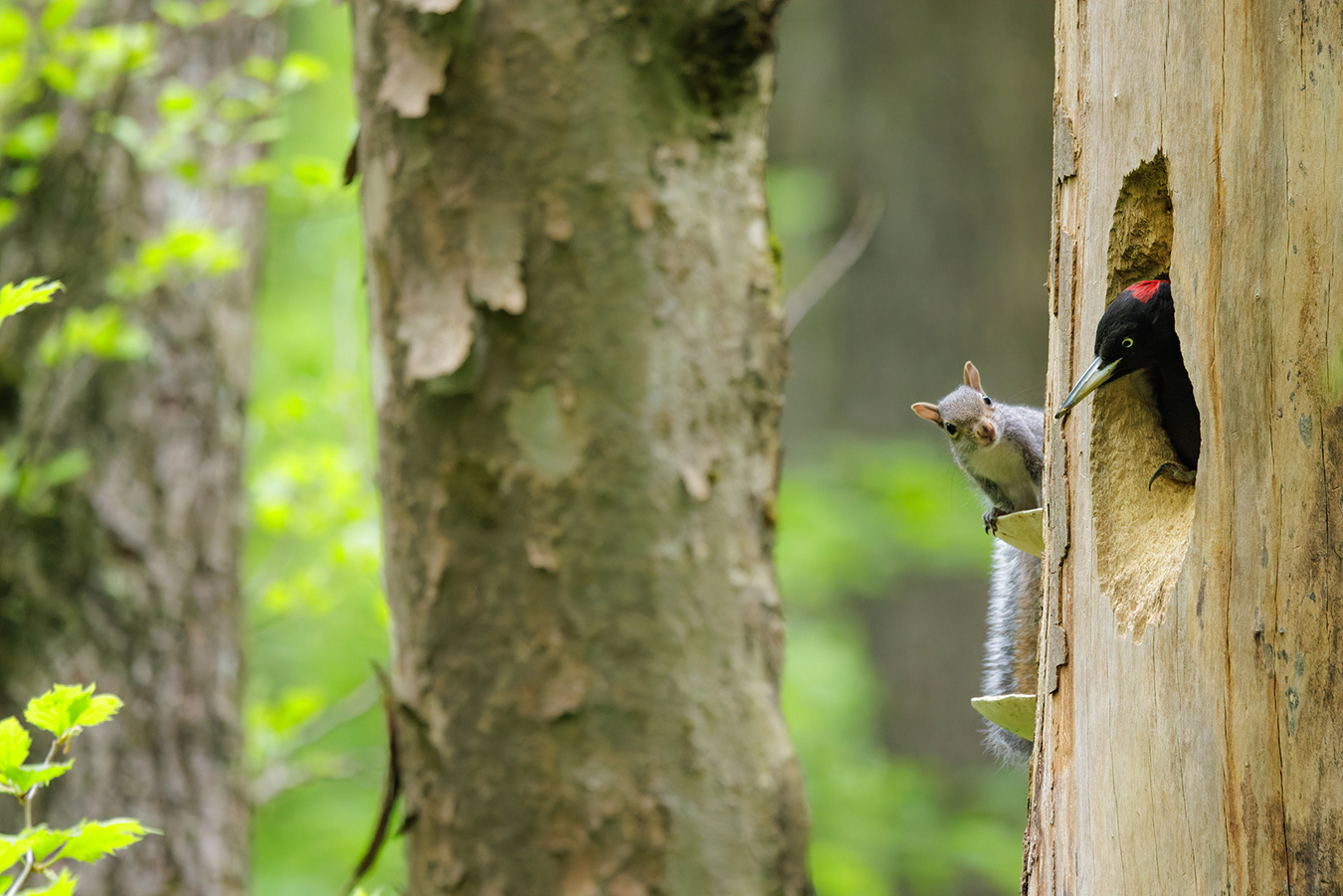
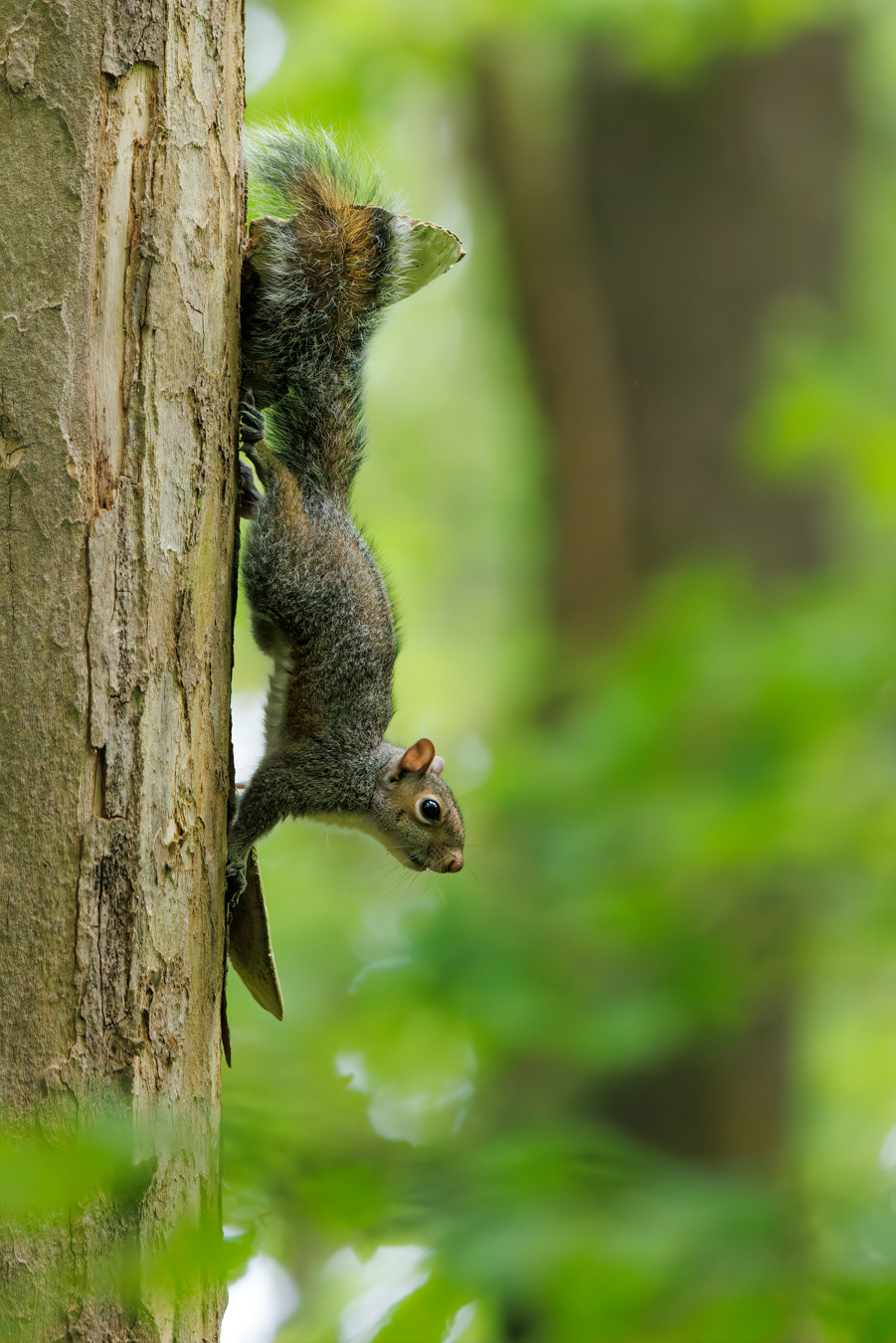
Life for the woodpeckers also included encounters with other animals: curious intrusions by grey squirrels, who were swiftly menaced by a parent gaze from the nest hole; visits from raptors like a buzzard, whose presence silenced the entire spring forest in an instant. And then there were other birds—great spotted woodpeckers also busy with nesting, tits, and mischievous jays who openly mimicked the calls of buzzards and tawny owls.
Sometimes it was the male woodpecker’s typical call “crek-crek-crek” call that signaled his arrival. Other times, it was the sound of his powerful wings cutting through the still forest air. And occasionally, they arrived in complete silence: just a gentle tapping on a nearby trunk, or the sudden appearance of a little red-topped head sticking out from the tree right in front of my hide, almost as if to challenge me playfully, with a teasing look. During incubation, when one parent returned to the nest, the other flied off soon after, searching likely for a decaying tree or a busy ant nest to feed. When feeding the chicks, however, they took turns at the nest, though visits were less frequent. Black woodpeckers store food in their crop and regurgitate it directly into the mouths of their young. Except when the prey is particularly large and difficult to swallow!
Life for the woodpeckers also included encounters with other animals: curious intrusions by grey squirrels, who were swiftly menaced by a parent gaze from the nest hole; visits from raptors like a buzzard, whose presence silenced the entire spring forest in an instant. And then there were other birds—great spotted woodpeckers also busy with nesting, tits, and mischievous jays who openly mimicked the calls of buzzards and tawny owls.
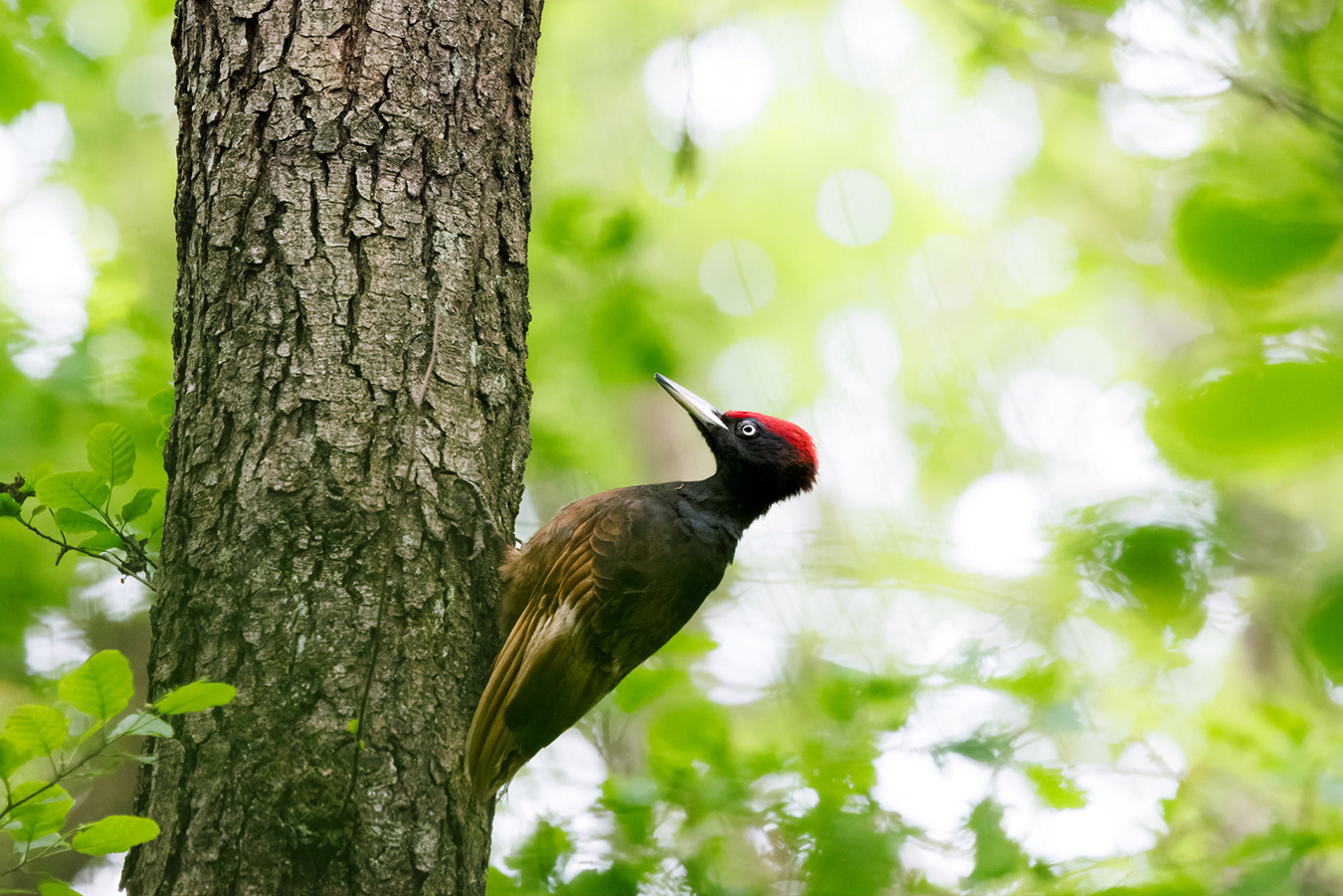
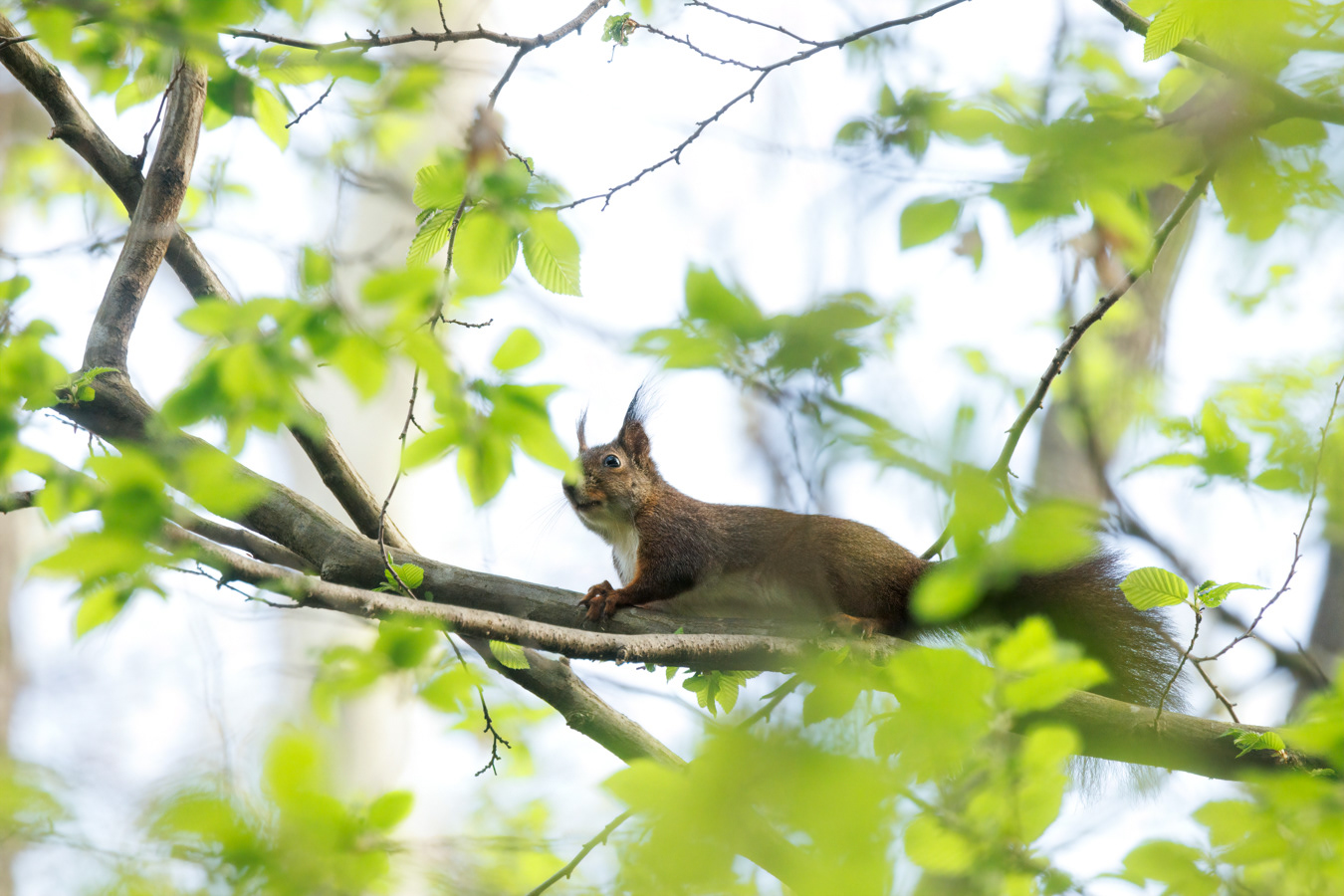
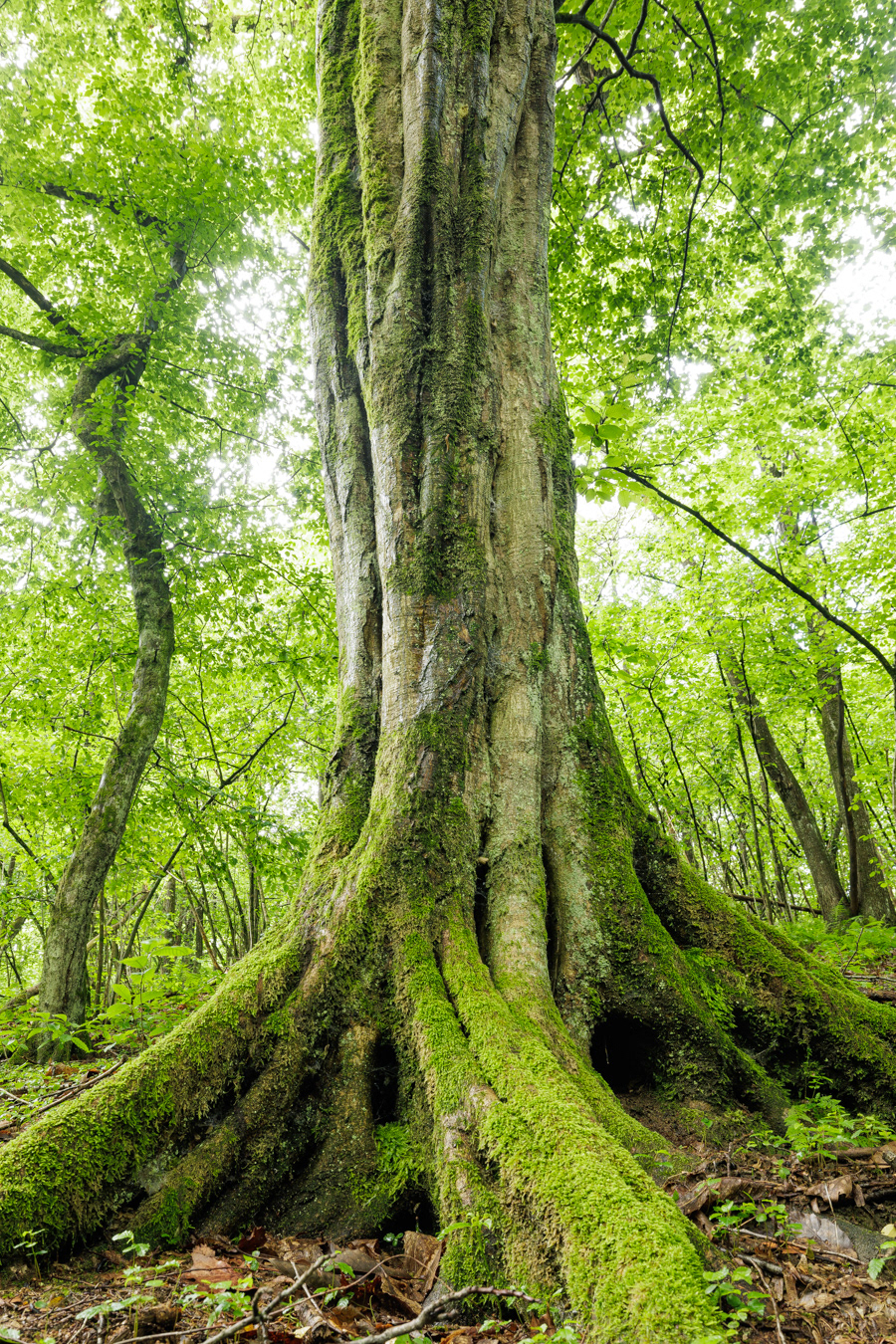
All the while, the forest changed. At first bare and bright, dressed in winter’s brown and beige tones, it then shifted to the tender green of budding leaves, to the lush growth of mosses and lichens, which were particularly abundant that year, until it became a shaded forest filled with dramatic contrasts and blurred foliage framing my subjects. Finding the optimal shooting position was a constant challenge. One day, after rain, branches were so heavy that obscured the nest; another day, new twigs near the hole compromised the clarity of the composition. And on another, the wind playfully changed the lighting in seconds, destroying any composition plans. A real challenge, but also a creative opportunity.
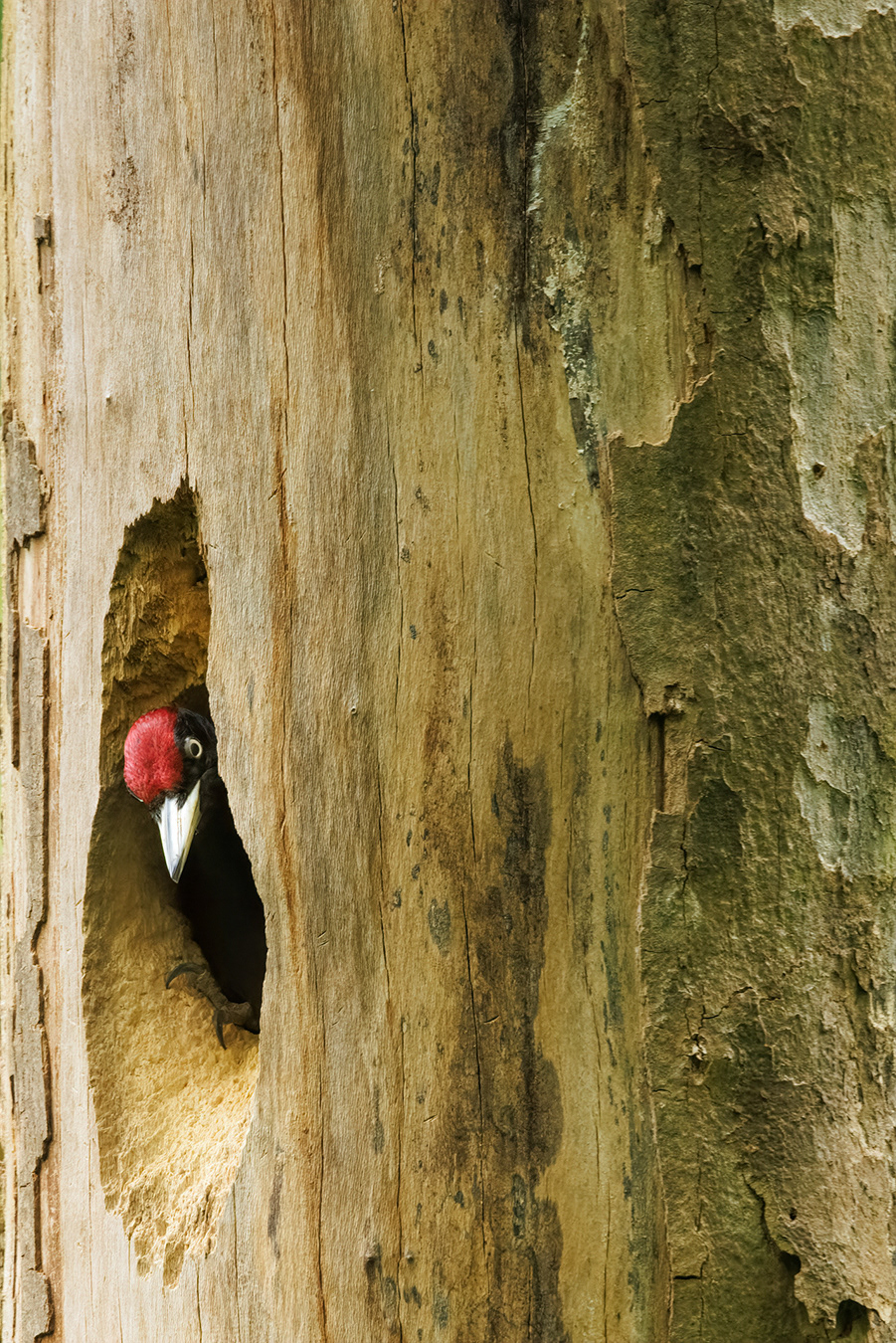
Only toward the end, when the chicks were about to fledge, I experimented with a more original approach: placing the camera at the base of the nesting tree, with a shorter focal length, and triggering the shutter remotely via wireless remote control. The woodpeckers didn’t mind at all.
During those weeks of intense experience, a word kept echoing in my mind. It was something I’d heard before, though I only intuitively grasped its meaning: forest bathing. An immersion in the forest. I spent long hours in that hide, sometimes with only three or four visits a day from the woodpeckers, but I was never bored. People would ask me, “How can you sit there for hours?” I couldn’t fully explain it. I could’ve stayed well past my scheduled time to leave. The forest had welcomed me into its world of green light, rustling leaves, shadows, and soft textures. Whatever was happening beyond the trees felt like a distant echo. It didn’t matter much whether the sky turned stormy or oppressively hot: the forest always softened everything. And I was never alone: the woodpeckers were there, along with creatures large and small, near and far. And to most of them, I was just a tree, or a bush. Maybe I was, even to myself.
I later discovered that forest bathing refers to a set of practices originating in Japan, aimed at enhancing mental and physical well-being through sensory immersion and mindfulness in the forest. And while I experienced the same healing effects, my experience was different. That kind of forest bathing still felt too human-centered, too utilitarian in its view of the forest. What I experienced was more a communion, a sense of being accepted—not just by the forest, but by the woodpeckers and every other species present. It was more like wildlife bathing, in a much broader, deeper sense.
During those weeks of intense experience, a word kept echoing in my mind. It was something I’d heard before, though I only intuitively grasped its meaning: forest bathing. An immersion in the forest. I spent long hours in that hide, sometimes with only three or four visits a day from the woodpeckers, but I was never bored. People would ask me, “How can you sit there for hours?” I couldn’t fully explain it. I could’ve stayed well past my scheduled time to leave. The forest had welcomed me into its world of green light, rustling leaves, shadows, and soft textures. Whatever was happening beyond the trees felt like a distant echo. It didn’t matter much whether the sky turned stormy or oppressively hot: the forest always softened everything. And I was never alone: the woodpeckers were there, along with creatures large and small, near and far. And to most of them, I was just a tree, or a bush. Maybe I was, even to myself.
I later discovered that forest bathing refers to a set of practices originating in Japan, aimed at enhancing mental and physical well-being through sensory immersion and mindfulness in the forest. And while I experienced the same healing effects, my experience was different. That kind of forest bathing still felt too human-centered, too utilitarian in its view of the forest. What I experienced was more a communion, a sense of being accepted—not just by the forest, but by the woodpeckers and every other species present. It was more like wildlife bathing, in a much broader, deeper sense.
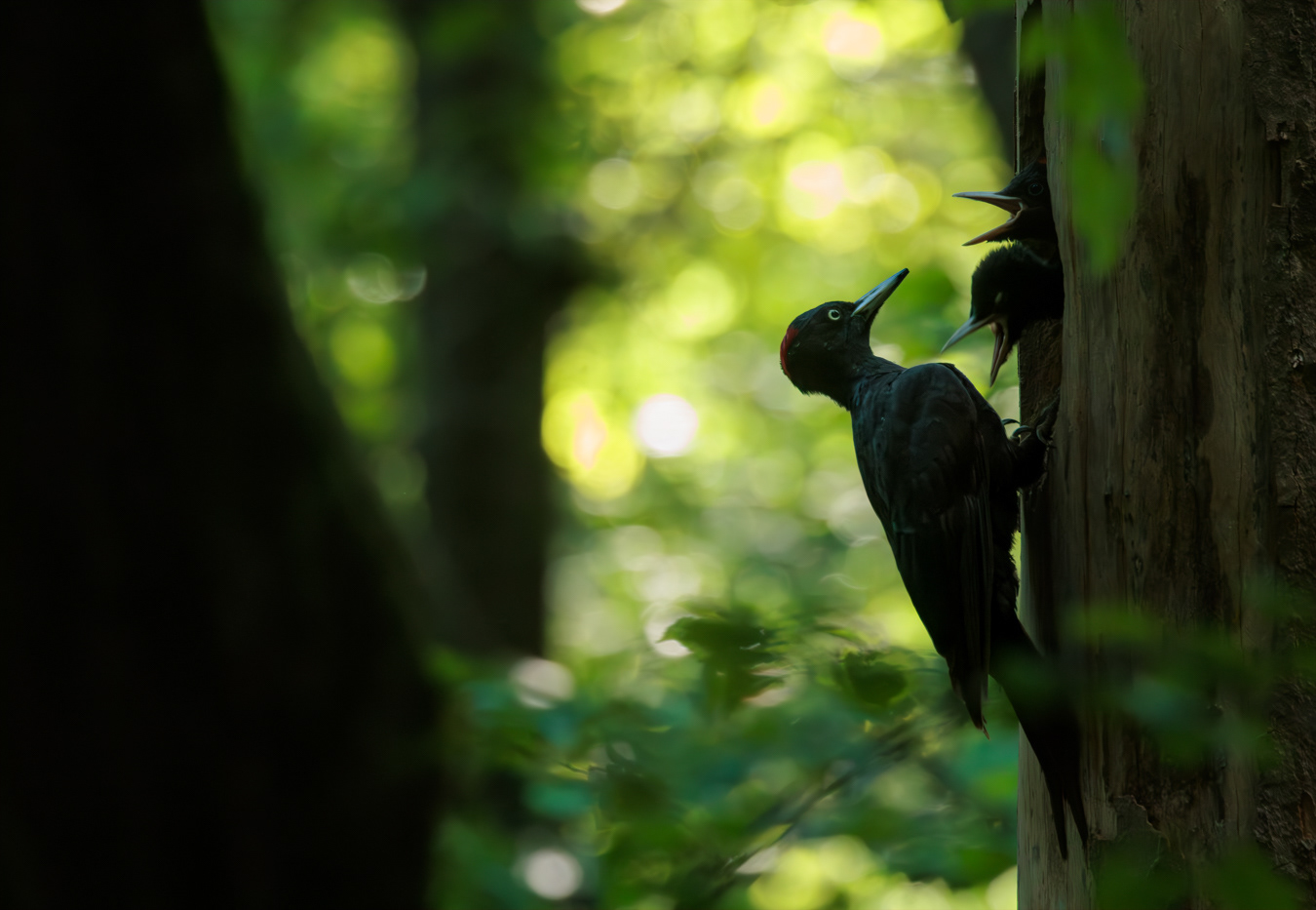
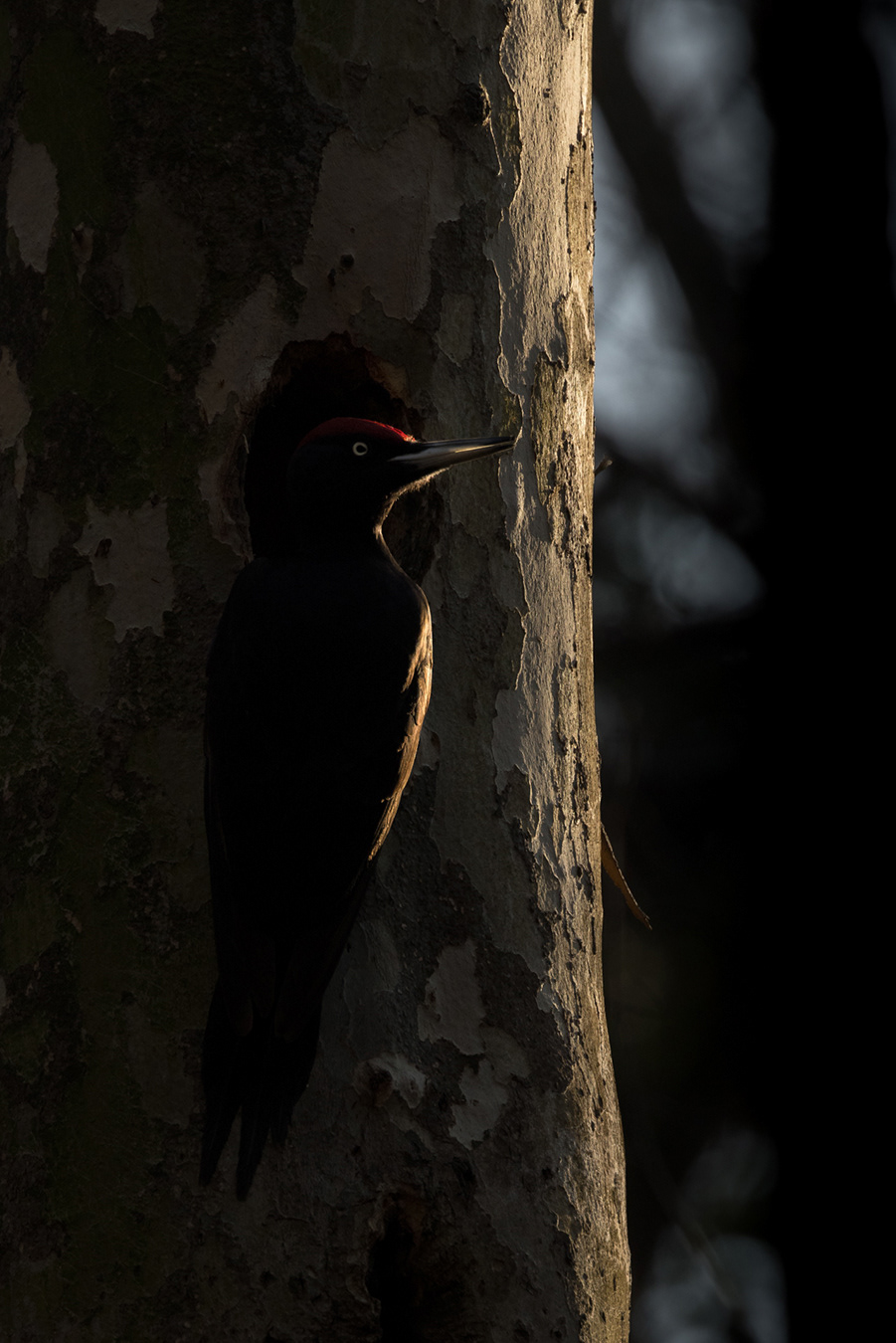
One day, when the chicks were already peeking out of the nest hole, I visited in the afternoon. Until then, I had always come in the morning. But in the soft backlight of that afternoon, I managed to capture some shots I truly love: dark, moody images where contrasts of shadows and light dominate and the woodpeckers appear as silent, elusive figures moving effortlessly through their suspended dimension. It felt like the most fitting way to convey the sensations the forest had been giving me for weeks. I promised myself I’d return again soon in a afternoon.
But in fact, that was the last time I saw them. A few days later, when I came back, it was clear the three fledglings had already left the nest. I heard their calls—or perhaps those of their parents—somewhere high in the forest canopy, but only briefly. The adventure had ended for the year. Almost without realizing it, I had spent the end of winter and all of spring in that forest. Every free moment outside of work and other commitments was spent there, living in a kind of marvelous, obviously green, bubble. And now, I felt orphaned. I regretted not having spent even more time there.
But in fact, that was the last time I saw them. A few days later, when I came back, it was clear the three fledglings had already left the nest. I heard their calls—or perhaps those of their parents—somewhere high in the forest canopy, but only briefly. The adventure had ended for the year. Almost without realizing it, I had spent the end of winter and all of spring in that forest. Every free moment outside of work and other commitments was spent there, living in a kind of marvelous, obviously green, bubble. And now, I felt orphaned. I regretted not having spent even more time there.
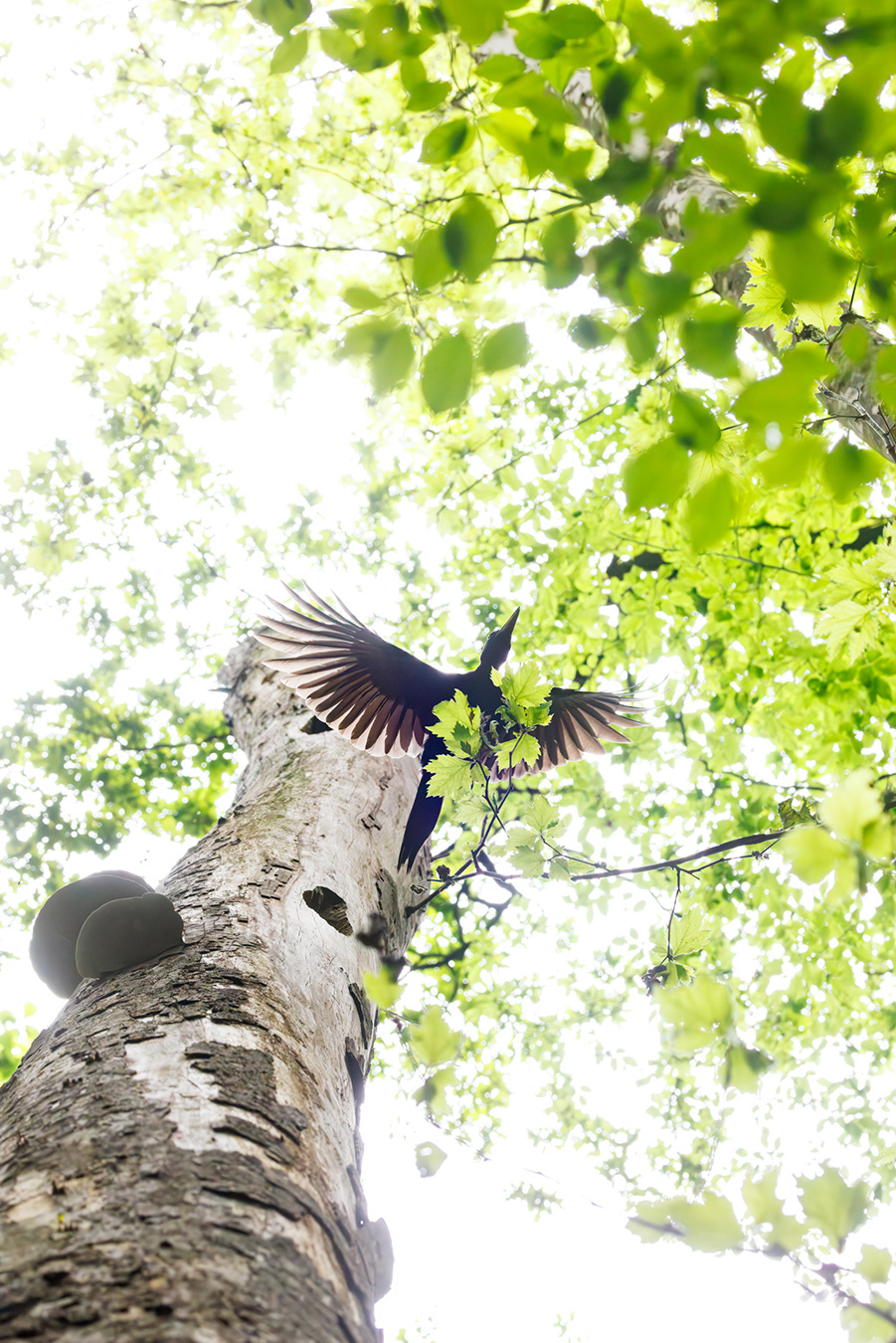
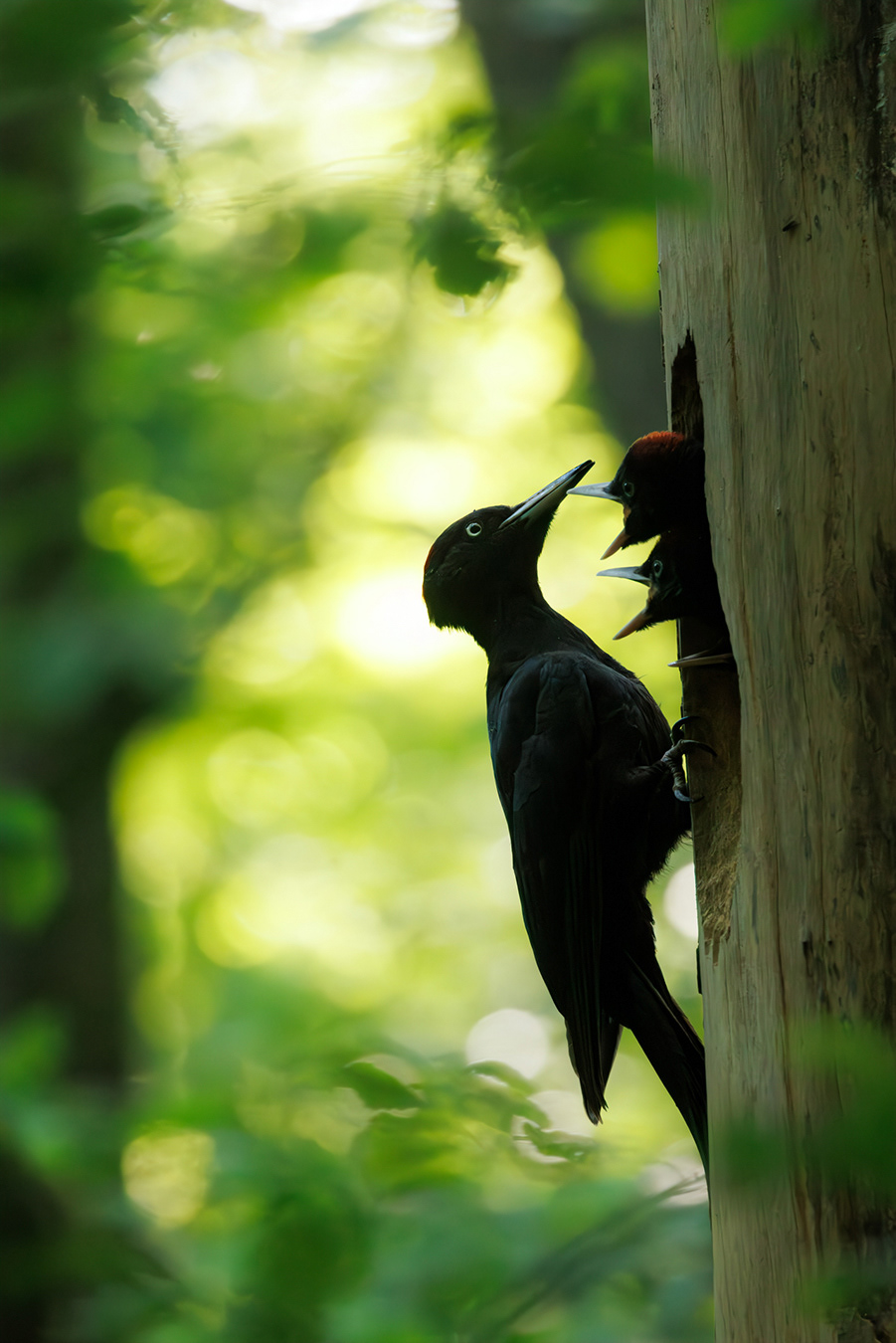
The following February, I returned. My heart leapt when the male reappeared and, just like the year before, began softly drumming on the old nest holes, trying to invite there the female. But the miracle didn’t repeat itself. In the end, the pair likely nested elsewhere. It’s well known that black woodpeckers rarely reuse the same nesting cavity.
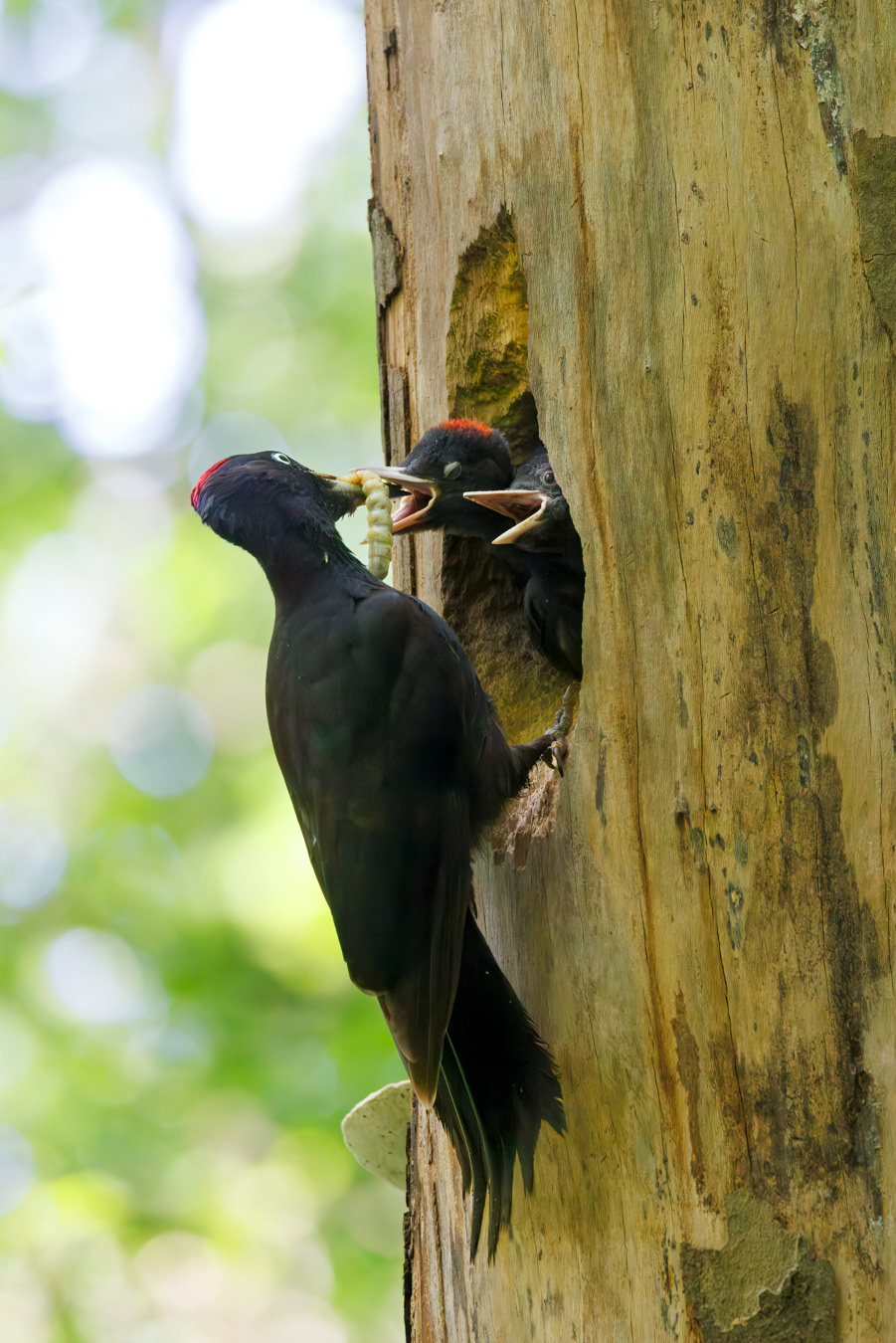
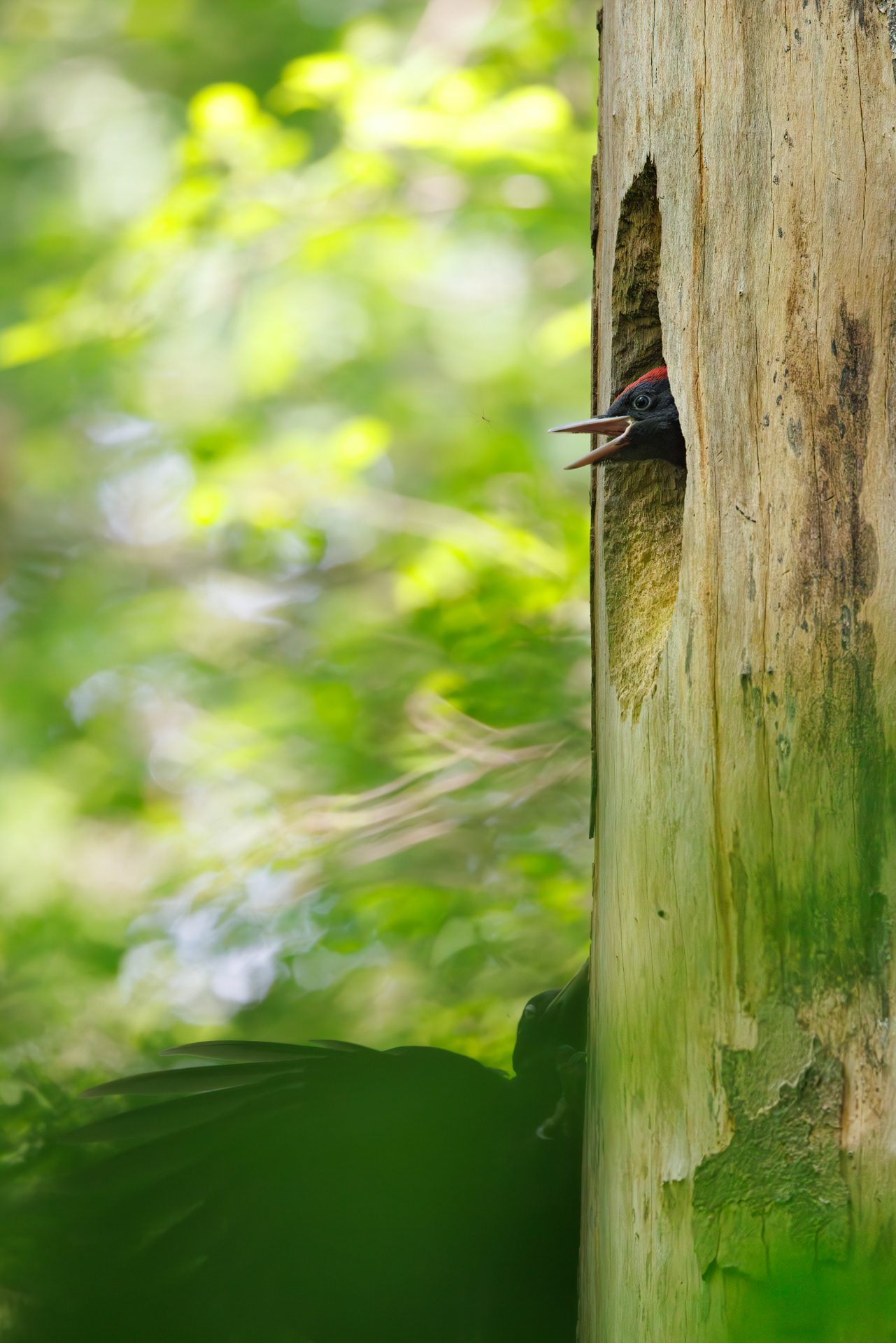
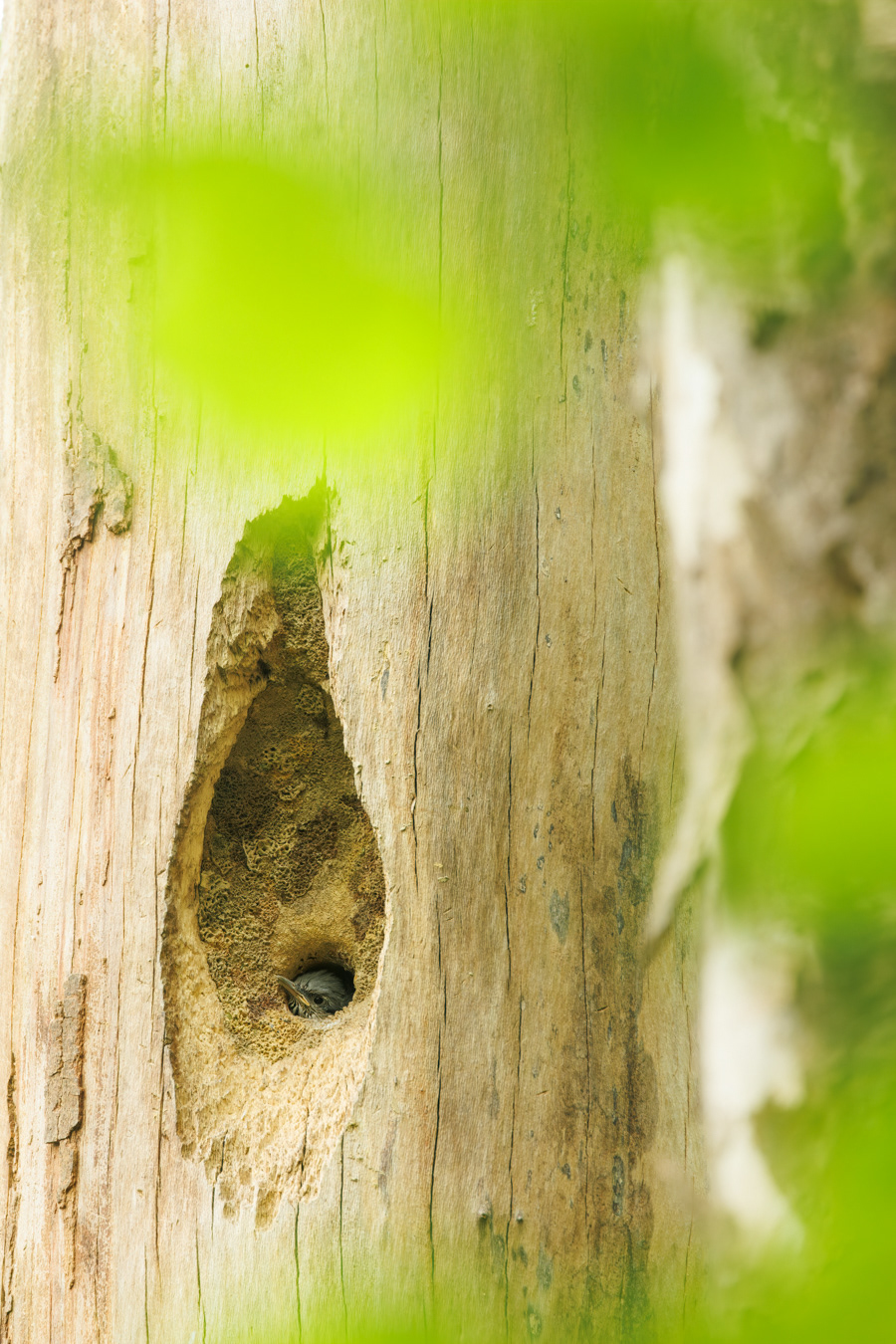
But a few months later, passing by, I noticed that the old hole seemed much smaller than I remembered. And, indeed, it had become home to a family of nuthatches (Sitta europaea), a bird species who use to adapt the hollow size to their need and dimension, by building a true mud wall.
I am still waiting impatiently for the next end of February...
Thank you!